The skirmishes and adventures in Wild West Exodus take place over varied scenery and environments. From the forested tribal lands of the Warrior Nation, to the dusty streets of the Lawmen protected frontier towns and the mesas and mountain paths rife with Outlaws and predatory aliens, the terrain will help and hinder your attempts to win the day.
The ground in a Play Area is divided into three forms to simulate this: Open Ground, Uneven Ground and Impassable Ground. As each player’s collection of terrain is going to vary, players should discuss before the Adventure which terrain features will be Uneven Ground and which will be Impassable Ground. Everything else in the Play Area is assumed to be Open Ground.
OPEN: The open, flat spaces of the Play Area are considered Open Ground and do not impede movement at all. The vast majority of the Play Area will be Open Ground (except in particularly challenging Adventures).
UNEVEN: Here we see terrain such as sand dunes, scrub, crops and even hills (although particularly well-worn paths and roads might be considered Open Ground). Walkways between buildings and railway tracks should also be treated as Uneven Ground.
All distance count as double when moving through Uneven Ground, so every inch moved counts as 2”. For example, a unit of Union Riflemen has a Quick of 5. It can only travel 3” through a woods (remembering that we always round up).
If troops move over Open Ground and Uneven Ground during the same Action, then their movement over Open Ground is normal and movement over Uneven Ground counts as double the actual distance travelled. Each model in a unit that spends a portion of their Move Action in Uneven Ground (even part of their base) count that portion of Movement as the distance traversed (remembering again to round up). It is suggested that models in a unit in the Uneven Ground are moved first to make maintaining Unit Coherency easier.
Example: A unit of Union Riflemen with a Quick of 5 makes a Walk Action. Normally the unit would be able to travel five inches in this Move Action. However, after the first three inches of the unit’s Walk Action it reaches Uneven Ground (in this case, a clump of trees which are Area Terrain). Each model in the Union Riflemen unit may only move a further inch into that Area Terrain (or may move two inches in open terrain).
IMPASSABLE: This terrain cannot be entered and usually represents locations in the Play Area that are to be avoided rather than traversed.
Destroying Terrain
Terrain cannot normally be destroyed in Wild West Exodus. Though the small arms fire (and even mortar shells and plasma blasts) can cause damage to the façade of a building or rip apart a tree we are more concerned in an Adventure with the damage done to any units seeking shelter. Should an Adventure require terrain to be destroyed to complete an objective, the Adventure will specify how this can be done.
Terrain
Terrain can be grouped into two main categories: Area and Buildings. Both of those types of terrain should be given a Base Size for determining its height. This may seem counter-intuitive as their actual width may vary wildly. What we are interested in is their height and more specifically whether their height makes it difficult to see enemy models beyond it. Terrain size is determined by turning a Base on its shortest edge and comparing it to the physical height of the terrain. A roughly agreed approximation is all that is needed. Terrain that is taller than an XXL base is classified as XXL+ and blocks Line of Sight to all Base Sizes.
Line of Sight and Terrain
For the purposes of determining Line of Sight, a model cannot see through terrain that is larger than their Base Size. Line of Sight can be drawn from/to a target from any part of its base, to a point vertically up to its Base Size. This makes a model’s interaction with scenery more straightforward. When measuring Line of Sight, trace an imaginary line from the two visible outmost points of the bases of the two models that Line of Sight is being checked for. Any terrain that lies within this corridor should mean that the target is considered Obscured when working out relevant modifiers to Aim checks etc.
Remember: If you cannot draw Line of Sight to any part of a model’s base, then that model cannot be made the Initial Target of an attack.
OBSCURED: For each piece of terrain that partially blocks the Line of Sight of a Shoot Action, the model making the Action receives a -1 Aim penalty. The model that is the target of the Shoot Action likewise receives +1 to their Grit Check for each piece of terrain that partially blocks Line of Sight to them.
During a game it will be obvious that certain terrain pieces will naturally confer certain advantages and drawbacks to any models deployed in, on or near them. We call these advantages and drawbacks Features and most terrain will likely have one or more of them.
DANGEROUS: Models in base contact immediately gain the Hazard Condition.
HIGHER GROUND: In many settlements and out on the frontier, hills are strategically important positions, overlooking the entire Play Area and giving support and Ranged units an excellent opportunity to shoot at the enemy.
While on Higher Ground a model can Focus their Aim checks for Free and count as Obscured against any unit except those who are also on Higher Ground. For Line of Sight purposes, terrain with the Higher Ground feature must physically be Base Size XL or larger, but regardless of their true size they are considered to be Base Size XXL+ and so models on it can always draw Line of Sight (and have it drawn against them) over smaller terrain pieces. When other pieces of XXL+ sized terrain block the Line of Sight of a· model on Higher Ground, you should get a model’s eye view to determine whether the models in your unit can see over the particular terrain piece.
IMPASSABLE: No model can be deployed on or be placed on or in this piece of terrain. Any model that would be moved to this location involuntarily stops its movement as soon as it touches the Impassable piece of scenery.
OBSTACLE: If a model cannot fully cross Area Terrain with the Obstacle Feature as part of a Move Action, and its base is wider than the Obstacle, then it cannot cross it. If the base can fit on the Obstacle then it can stop on top of it. Depending on the height of the Obstacle, players may consider it Higher Ground. Models may need to climb to cross an Obstacle. Models on an Oval Base may cross Obstacles if they have the LIVING MOUNT Trait.
UNEVEN: Halves distance travelled for Move Actions that cross it.
Area Terrain
Area Terrain covers loose groups of individual pieces, such as forests, rocky ground, water features and so forth. If the terrain piece requires a Get In or Get Out Action then it is a Building. Otherwise it is Area Terrain.
Before the Adventure begins, players should identify what Area Terrain is present. While any part of any model’s base is in inside a piece of Area Terrain it is affected by the features of that Area Terrain.
Below are some common types of Area Terrain, however players should agree on variations so as best to suit their own scenery collections. All area terrain gives the obscured bonus unless specified otherwise.
Types of Area Terrain
DEEP RIVER: Uneven, Dangerous
FENCE: Obstacle.
FOREST: Uneven.
HILLS: Higher Ground.
HOT SPRINGS: Uneven, Dangerous.
JUNGLE: Uneven.
MESA: Uneven, Higher Ground.
OUTHOUSE: Obstacle.
ROOFTOP: Higher Ground
SHALLOW STREAM: Uneven.
SMOKESCREEN: Uneven, provides Shrouded Common Rule and Disorder Condition.
STACK OF CRATES: Uneven, Obstacle.
TAR PIT: Uneven, Dangerous.
WATERFALL: Uneven, Obstacle.
Buildings
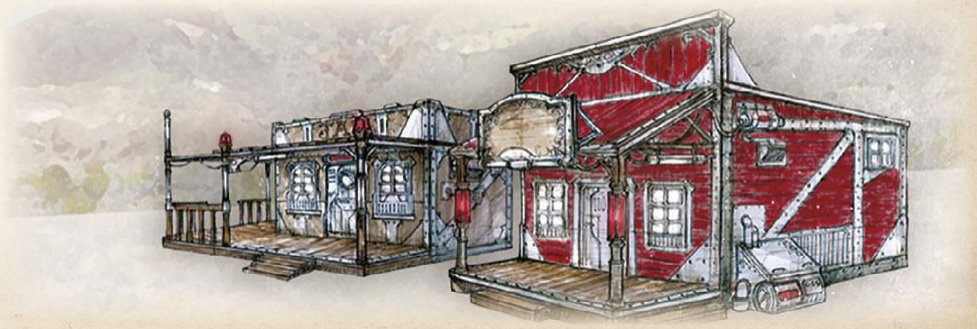
Before each game, players should identify any scenery on the board that will be classed as a Building. This will usually be a man-made structure with (ideally) four walls, one or more floors and a roof. Every player will likely have their own unique collection of buildings and scenery, so some common sense and communication with your opponent will be necessary when dealing with your own buildings.
Small or unusually shaped buildings should always be considered Impassable and treated as Obstacles rather than true buildings. For larger buildings that can be interacted with during an Adventure, players should agree on a Base Size Value before deployment. This will usually be XXL if it is a single storied building or XXL+ if it has two or more levels. A Building should be large enough to have a capacity for 10 small based models to occupy a level. Should a level be smaller than this it is suggested that it is not considered to have a capacity.
Units will always occupy the lowest level possible in a building first. Higher levels of a building cannot be occupied unless the lower level is occupied.
Buildings are impassable to all models except for Small and Medium Based units. Only one unit of Hands or Support may occupy a level of a building at a time but multiple Boss or Face units can occupy the same level. The unit is considered to be in Coherency while occupying the building.
If a unit moves within 3” of an unoccupied building, it may enter it by making a Get In Action, though it cannot do this in the same turn that it makes a Charge or Get Out Action. A capacity of 10 per level is the standard for a building and should be assumed. Place representative models from the unit on a balcony of an occupied level or next to the building to remind you that the unit is inside and place the rest of the unit aside from the Play Area.
In almost all respects, it is best to think of the unit now occupying the space that is represented by the building model - its walls are the edges of the unit. All distances relevant to the unit (for Shoot and Strike Actions etc) are measured to and from the building itself.
When entering (or leaving) a building, you do not have to rely on physically modelled doors or entrances. It is assumed the models either sprint to the nearest entrance, or else use their weapons to make their own. To leave the building on a subsequent turn, an Unengaged unit must make a Get Out Action and be placed within 3” of the building. Units must be placed in Coherency when taking this Action.
Units in a building are considered to automatically have made an In Cover Free Move Action (so counts as Obscured by the building), and receive the Hunkered Condition while inside. Furthermore the model’s Base Size is still used for claiming the Obscured advantages from any intervening terrain. Units in Buildings can only make In Cover, Strike, Shoot and Get Out Actions.
Shooting into Buildings
A unit in a building can be targeted by any enemy that can see the building itself. In other words, if an enemy can see the building, it can see the unit inside it. Where a building contains multiple units, hits are allocated to the unit with the greatest number of models first (or randomly decide if a tie). Remember a unit in a building has the Hunkered Condition and that any penalties to an enemy Shoot Action and bonus to your model’s Grit are applied based on the Embarked model’s Base Size, not the Base Size of the building. The Initial Target model in the unit may be chosen by the player whose unit is in the building. The unit receives the Obscured bonus for being In Cover in the building.
Example: Sam is playing a game with her Order against George’s Lawmen. Sam has a unit of three Cor Caroli Nyx Embarked in the Saloon. The Saloon is a two-story building so counts as XXL+. It is George’s Activation and he wants to shoot at the Nyx Cohort with Virgil Earp.
As they are Embarked in a building Virgil can shoot at the Nyx as long as he can draw Line of Sight to any part of the Saloon though his actual target point is the closest part of the building model within Line of Sight. As he is standing in the middle of the street directly in front of the saloon it should pose no difficulty!
However, there is a piece of Medium base sized terrain between Virgil and the closest part of the building model. As the Nyx are on Medium bases, they gain the +1 Grit modifier for being Obscured by terrain, as well as the +1 Grit modifier for being Obscured by the building and a +1 Grit modifier for being Hunkered as they are occupying a Building. George has the choice of either having Virgil stand still and spending all his Action Points on multiple Shoot Actions or moving Virgil so that the terrain is no longer between Virgil and the closest point of the building, causing the Nyx to no longer count as Obscured from that piece of terrain (but still Obscured as they are in a building).
Template Weapons and Engulf
Template weapons that have the Engulf quality can be devastating against enclosed spaces. Every model occupying a building is considered under the template should the building the unit is in be hit by the centre or centreline of one of those weapons. The Deadeyed Common Rule does not enable an enemy to target a specific model in a building. Successful hits using a template weapon against a unit in a building will only cause a single hit.
Shooting Out from Buildings
Units within a building are considered to have a 360-degree Line of Sight, which can be drawn from any part of the building floor they are in. It is imagined models smash or open windows, or break small holes in the walls to take shots out of where necessary. Treat shooting exactly as a Shoot Action, accounting for any Obscured modifiers etc. Remember that the building itself does not confer a -1 penalty to your Aim for Shoot Actions as models within count as having made the In Cover Action. Of course units suffering from the Hazard Condition cannot gain this benefit because they cannot take Free Actions. Range is measured from the closest point of the building to the target.
Strike Actions and Buildings
If a unit moves into base contact with a building that is occupied by an enemy unit, the units are considered to be Engaged. Regardless of the range of their Melee weapons, units can only Engage (or be Engaged) in a building if an enemy unit is in base contact with the building. Only units in the lowest floor of a building can be Engaged in combat but once all defenders on the lowest level are slain, units occupying the next highest level will automatically rush down to meet the attackers. However, to represent the difficulty of digging an enemy unit out of a well defended building, the attacking unit can never benefit from Charge Action bonuses against a unit in a building nor do Melee Weapon ranges for any Engaged unit extend beyond the base of the building itself.
While Engaged with a unit in the lowest level of a building, the Initial Target model in each unit may be chosen by that unit’s controlling player, representing individuals stepping into the breach to fight. Where a building contains multiple units, hits are allocated to the unit with the greatest number of models first (or randomly decide if a tie).
Rooftops
The roof of a building can often allow units to be positioned on them. In all respects units on rooftops should be treated as having Higher Ground and are not considered to be inside the building or in base contact with it.
Large Buildings
Most structures in Wild West Exodus can be assumed to be small enough that a model can cross them in the time represented by an Activation. However, if you have buildings that are comprised of multiple sections you can rule that they are large buildings. If players agree, for particularly large buildings such as a saloon, the capacity of a level may be increased to 20 or 30 (always increase in tens if possible) and should be specified before the game begins.
For structures split into discernible sections, before the game starts, agree with your opponent how many sections there are to a building. Each section is treated as an individual building and a unit may not be spread or split between sections.
Units can move between sections as per the standard rules and a unit can move from one section to the next by taking a Walk Action (and this is the only time that such an Action is permitted in a building). Simply move your models indicating occupation from one section to the next. Units in each section must be targeted individually. Units can only move between sections that touch.
Source: Wild West Exodus Rulebook v1.09, pp. 34–39. © Warcradle Studios. Reproduced for archival purposes. Download the official rulebook (PDF).